
Bio
David Edward Walker is a liberation psychologist, writer, and singer-songwriter whose life’s work blends art, intellect, and service toward assisting individual, family, and community healing. His novels, Tessa’s Dance, and its sequel, Signal Peak, are love letters to Yakama youth, while his memoir and critique of the U.S. mental health system’s historical harms in Indian Country, Coyote’s Swing, rises toward the “good trouble” of sociocultural intervention. With his original songs and poetry he hopes to lift and open hearts, and in his psychological work, whether individual or community, he aims to center wisdom, collaboration, and the achievement of real, lasting change in place of linearity and “talk-down” approaches.
Early Days
David was born in Lansing, Michigan, and spent much of his young adult life in the northern suburbs of Detroit, working as a dishwasher, cab driver, coffee salesman, and clerk. He overcame numerous personal challenges to complete a bachelor’s degree in psychology at Oakland University (magna cum laude) and his PhD in clinical psychology with a cultural focus at the University of Detroit.
Chasing the Dream
Soon after obtaining his doctorate, David began chasing a lifelong dream as a performing singer-songwriter under the stage name David Folks. His Native-themed song “Joshua Maiden” achieved college airplay on syndicated folk shows, and David was soon invited to join the board of DreamCatchers, a Detroit-area musicians’ project benefiting Native causes. He contributed two songs to DreamCatchers compilation CDs and performed at numerous regional concerts and events.
David’s involvement with DreamCatchers increased his local visibility, and he soon recorded two compact discs, Roadside Park and Refusing to View, which achieved college radio airplay across the U.S. He toured regionally and nationally, sharing the stage with songwriting luminaries like Rodney Crowell, Richard Shindell, Richie Havens, Jonathan Edwards. Clive Gregson, Pierce Pettis, and the great Utah Phillips.
In 1997, David was auditioned and flown down by festival organizer Rod Kennedy to perform at the 25th Anniversary Kerrville Folk Festival. The same year, he was offered an hour-long performance at Nashville’s Bluebird Café warming up for Rodney Crowell (Country Music Association, Male Vocalist of the Year, 1990).
David’s songwriting work soon began receiving strong reviews in such publications as musicHound’s Guide to Essential Folk (1998), Dirty Linen, Detroit Monthly, Detroit’s Metro Times, and several other publications. His music was even featured at newly-minted Starbuck’s locations nationally through Hear Music (Concord Music Group).
In meeting and even getting paid by childhood folk idol Tom Paxton after performing at Kerrville Folk Festival, David reached a career high and decided it was past time to step away from the chaos and competitiveness of the music business and return home to be closer to his wife and sons.
Serving Native America
In 2000, Dr. David Edward Walker accepted a position as the sole professional psychologist serving the Confederated Tribes and Bands of the Yakama Nation through the U.S. Indian Health Service and relocated with his family to central Washington.
During this period, he experienced significant spiritual growth, deepened his connection with his Missouri Cherokee heritage through his father and grandmother, met many esteemed local Native elders, participated in traditional ceremonies, and became more involved with the Bahá’í faith.
From the outset, David found himself in conflict with the Indian Health Service’s Western medical model ideology and bureaucracy. Paradoxically, his challenges with IHS tended to strengthen his relationship within the Yakama Nation community. Working collaboratively with community members over several years, he helped design the first two Pathways to Hope and Healing conferences and the first Yakama-centered behavioral health program, Níix Táawaxt (“good growth to maturity”). As manager of this program, he was able to leave the Indian Health Service, while continuing to work under contract with Yakama Nation.
Scholarship & Critical Writing
Over time, David developed scholarship in examining the role of the U.S. mental health system in Native America, discovering within its history a hitherto unexamined source of cultural oppression. This passion was sparked when he noticed internalized racism among Native youth and young adult clients, including beliefs that their academic or personal struggles were rooted in their own “genetic inferiority”—ideas directly traceable to early 20th century psychological practices in Indian boarding schools.
David’s earliest critical writing on this topic began with a chapter challenging ADHD diagnosis in Indian Country for Critical New Perspectives on ADHD (Routledge, 2006), which received the National Association for Special Needs Academic Book Award (UK). At that time, Native American boys in the U.S. were labeled ADHD at a far greater rate than youth of other ethnicities. To his chagrin, rather than this statistic shifting downward, youth of color in other ethnicities eventually caught up.
In 2012, he and Dr. Albert Galves published “Debunking the ‘brain science’ behind attention deficit hyperactive disorder” in Ethical Human Psychology & Psychiatry (EHPP). Deepening his research into the early days of the U.S. mental health system in Indian Country, David published four historical critiques with Indian Country Today in 2015 and 2016 that generated significant public engagement and debate. In 2022, he offered another extensive analysis and critique – again for EHPP journal – of efforts on the part of the World Health Organization (WHO) to export Western psychiatric medical models of care into Indigenous communities worldwide without respect for their cultural traditions.
Recognition
David’s first novel, Tessa’s Dance, medaled in the 2013 Independent Publisher Book Awards, and its sequel, Signal Peak, won a 2013 IndieFAB Book of the Year Award. A 2014 review in Indian Country Today highlighted the two novels’ sensitivity and resonance with contemporary Native life, and emphases on the power of tradition, psychological healing, and cultural revitalization.
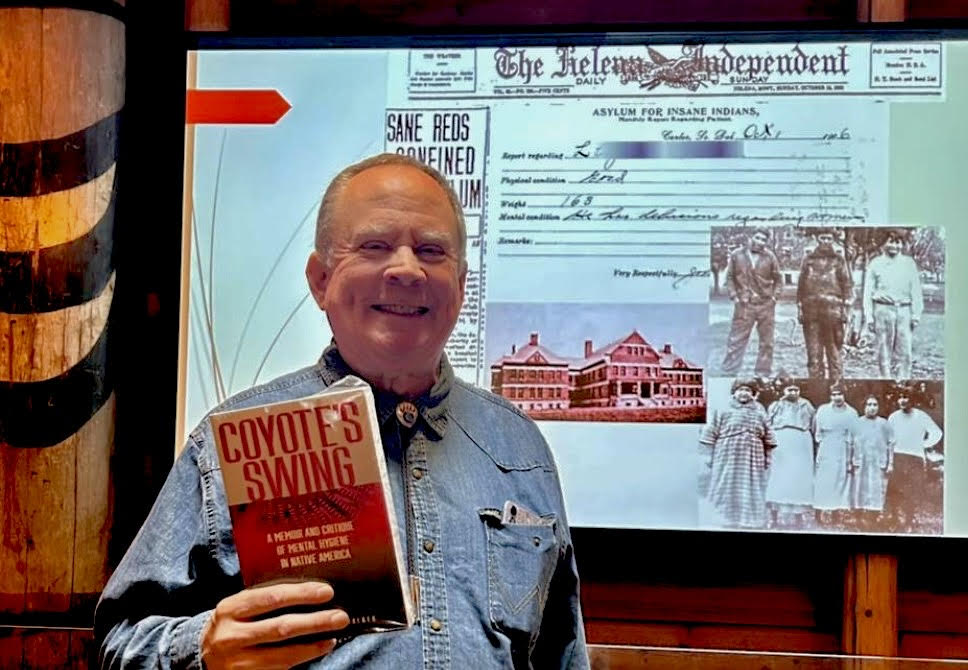
Coyote’s Swing: A Memoir & Critique of Mental Hygiene in Native America(Washington State University Press, 2023) is his first nonfiction book and the only comprehensive history and critique of the U.S. mental health system in Indian Country. This book represents the culmination of David’s effort across over two decades to expose the dark side of this system. Coyote’s Swing was chosen out of scores of candidate books to be named a University Press Week Selection. David received a Lifetime Achievement Award in 2023 from the International Society for Ethical Psychology & Psychiatry (ISEPP).
Currently
David continues to maintain close relationships within the Yakama Nation community. He lives with his family on the Port Madison Indian Reservation in western Washington state and recently began consulting with the Suquamish Tribe. David just finished a new novel, The Insignia Pin, and is working to pull together a collection of his best poetry. Check out his poetry and subscribe to his substack, Reflections from the Burning House. He’s still writing and recording songs in his home studio for his YouTube channel and bandcamp page. His favorite pastime is being present and involved with his family.
Dave’s Talking Stick
Books
- Coyote’s Swing | Learn More | Purchase
- Tessa’s Dance | Learn More | Purchase
- Signal Peak | Learn More | Purchase
Substack Blog
Articles
- A Case Before the U.S. Supreme Court Could Surge the Psychiatric Labelling and Drugging of Native American Foster Youth
- WHO Owns the Language
- A Book Review of ‘The Medicine Valley Series: Tessa’s Dance and Signal Peak’
- How the US Mental Health System Makes Natives Sick and Suicidal
- Lunacy, Crazy Indians & the Witch’s Hammer
- ‘A Living Burial’: Inside the Hiawatha Asylum for Insane Indians
- Betrayal by Labels: The Feebleminded, ADHD Native Child
- Debunking the Science Behind ADHD as a “Brain Disorder”
- ADHD as the New ‘Feeblemindedness’ of American Indian Children
- Speaking in the Borrowed Language: Mental Health as Cultural Oppression
- Prediction of Recovery for Closed Head Injured Adults
- David Walker on Indigenous Peoples and Western Mental Health
Awards & Accolades
- ISEPP Lifetime Achievement Award 2023
- University Press Week Selection
- Tessa’s Dance, IPPY, 2013
- Signal Peak, IndieFAB, 2013
Media
Songs
David’s Gallery





Missouri Cherokee Descendent
David wishes to make clear that he is not enrolled in any federally- or state-recognized tribe or organization and makes no claim thereby. He requests that conference organizers, interviewers, and others please remember that he is no more and no less a “Missouri Cherokee descendent.”
While acknowledging his family’s European roots, David refuses to deny his Native heritage through his father, paternal grandmother, and generational grandmothers, Elizabeth Gibson, and Elizabeth Jane Albina Alexander, who were compelled to suppress who they were in the times in which they lived.
He states that he’s never profited or benefited from Cherokee connections in his family – indeed, they were buried by certain ancestors as a source of shame, and it’s been his life task to undo this damage.
If you are curious to know more, these family connections are detailed in the memoir portions of Coyote’s Swing.
Please feel free to contact him with any further questions.
